What it involves
Metoidioplasty uses the clitoris and surrounding tissue to create a small penis. It differs from phalloplasty, which uses tissue from a donor site such as the abdomen or forearm.
Your anatomy and goals are central to the discussion. Ask about size, sensation, urination and which sexual activities matter to you.
Surgical pathways
Standard metoidioplasty with urethral lengthening
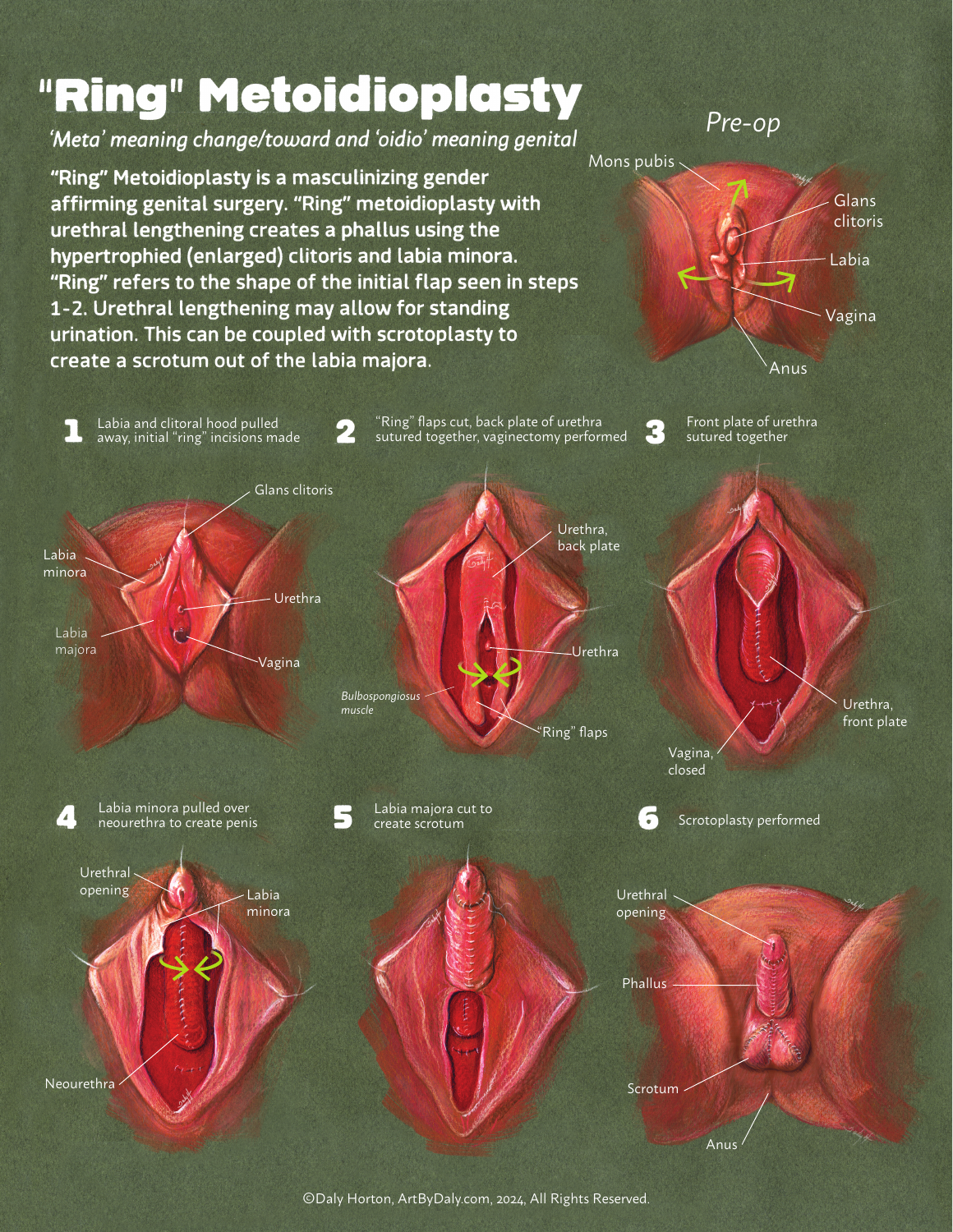
The first operation combines metoidioplasty and urethral lengthening with vaginectomy and vaginal closure, scrotoplasty to create the scrotum, and perineoplasty to reconstruct the perineum. A muscle flap is not used in this standard operation.
Monsplasty and testicular implants are routinely offered about six months after the main reconstruction. Monsplasty reshapes tissue over the pubic area. You can choose not to have either of these additional procedures.
Superextended metoidioplasty
This option adds an initial operation before the remaining reconstruction. The erectile bodies are released from the pubic bone. A buccal graft—tissue from inside the cheek—is placed during straightening. The initial operation takes approximately two hours and is typically an outpatient procedure.
About six months later, the team performs the remaining reconstruction, including creation of the fixed portion of the urethra (pars fixa), scrotoplasty, vaginectomy and vaginal closure. Monsplasty and testicular implants can then be offered about six months after that reconstruction—approximately 12 months after the initial release operation. Each stage is planned six months apart.
Discuss the differences between this approach and standard metoidioplasty with your surgeon, including the additional operation, recovery and expected function.
Without urethral lengthening
The operation includes a perineal urethrostomy, scrotoplasty, vaginectomy and vaginal closure, and perineoplasty. Urine passes through the opening in the perineum rather than through the tip of the penis.
Monsplasty and testicular implants are also routinely offered about six months after the main operation, according to your preferences.
Illustrated explanation
This poster depicts a ring metoidioplasty technique with urethral lengthening and related reconstruction. It is one illustrated approach, not a requirement to have every depicted component.
View ring metoidioplasty illustration
Preparation
Review your health history, prior operations, medications and goals with the team. Ask which steps need to be completed before a surgical date can be confirmed.
Consultation and preparation guide →Discuss whether the team needs additional assessment of your anatomy or medical history. Ask about postoperative support, work, local stay and travel for your planned operations.
Expected function
The estimates below reflect Dr. Gupta’s counseling. They are not guarantees or independently audited website outcome data.
Sensation
Dr. Gupta describes sensation as preserved in nearly all patients after metoidioplasty. Orgasm is generally preserved as well. These are separate aspects of sexual function, and neither is guaranteed for every patient.
Standing to urinate
Urethral lengthening does not guarantee that you will be able to urinate standing. In Dr. Gupta’s practice, even with the most favorable anatomy, a technically successful operation and an uncomplicated recovery, the chance is about 50%. This estimate should not be read as the success rate for every patient having metoidioplasty.
Penetrative intercourse
Dr. Gupta counsels patients not to expect to use the reconstructed penis for penetrative intercourse after metoidioplasty.
Additional length with superextended surgery
Superextended metoidioplasty may provide about one additional inch of length. This is an approximate potential gain, not a promised result or the total length of the penis. Discuss the expected benefit for your anatomy alongside the additional operation and recovery.
Healing and complications
Dr. Gupta describes wound-healing complications after metoidioplasty as less frequent and less severe than after phalloplasty. Minor wound complications still occur in approximately 40–50% of patients in his counseling estimates.
For the urethral-lengthening pathway, he estimates the risk of urethral fistula or stricture at about 25%. A fistula is an unintended opening that can allow urine to leak; a stricture is narrowing of the urethra. This is one estimate for the complication group, not 25% for each condition.
These categories can overlap, so the percentages should not be added together.
Risks of superextended surgery
Superextended metoidioplasty adds an operation to the treatment sequence. Mobilizing the erectile bodies carries a theoretical risk of damage to their nerves or blood vessels. There are not enough data to reliably quantify this risk; the absence of a numerical estimate should not be interpreted as evidence that it is extremely rare.
Testicular implants
Dr. Gupta uses Coloplast Torosa testicular implants: a silicone shell filled with saline. Solid implants are another type, but are not used in this practice. Torosa comes in several sizes; the surgeon selects the size during the operation to fit the reconstructed scrotum. Torosa manufacturer information →
Discomfort and repositioning
An implant can move too high toward the groin canal or press against the pubic bone, causing discomfort. Repositioning may be needed. Dr. Gupta’s approximate counseling estimate for repositioning is 2–3%; no specific follow-up period is assigned to this estimate.
Infection and erosion
Infection and erosion through the surrounding tissue can occur, but Dr. Gupta describes these as uncommon for the testicular implants themselves. No numerical estimate is assigned. The 2–3% repositioning estimate is not an infection, erosion or overall complication rate.
These are Dr. Gupta’s October 2026 practice descriptions and counseling estimates, not independently audited website outcomes. Manufacturer information supports device description and sizing, not these outcome estimates. Penile implant revision and infection figures should not be applied to testicular implants.
Testicular implants alone
When testicular implants are placed without a penile implant at the same operation, surgery takes approximately 30 minutes. No drain is used, and you go home the same day. Routine follow-up is approximately four weeks later.
Monsplasty with testicular implants
When monsplasty and testicular implants are performed together, the operation takes approximately two and a half hours and usually involves an overnight hospital stay. A drain remains in place until the postoperative visit, usually between days five and seven. Plan to stay in the area until this visit; you can return home after drain removal.
Overall recovery takes approximately four to six weeks. The main risks discussed are wound breakdown and infection. Dr. Gupta’s approximate counseling estimate for minor wound breakdown is 15%; it rarely requires another operation. No numerical infection estimate is assigned.
Recovery and follow-up
Flying home
You may fly home once you have completed the local stay for your operation and the team has cleared you. There is no separate waiting period for flying after metoidioplasty. The local-stay requirements for each stage are described below.
At your preoperative visit, your care team will explain who to contact during and after office hours, which symptoms need an immediate call, and when to seek emergency care.
Standard metoidioplasty with urethral lengthening
The operation takes about three and a half hours and usually involves an overnight hospital stay. Plan to remain in the area until all catheters have been removed—usually about four weeks. Your team confirms removal timing based on healing.
You go home with a urethral catheter, a suprapubic tube and a perineal drain. The usual removal milestones, measured from surgery, are:
- Perineal drain: within about the first week.
- Urethral catheter: approximately two to three weeks.
- Suprapubic tube: approximately four weeks.
After the initial superextended operation
A catheter and bolster dressing remain in place for about one week. Plan to stay locally until the team removes them; you can then return home. This guidance applies to the initial release and graft operation, not the later reconstruction.
After the later superextended reconstruction
The reconstruction performed about six months after the initial release and graft follows the standard metoidioplasty guidance: approximately three and a half hours of surgery, an overnight hospital stay, and a local stay until all catheters are removed—usually about four weeks.
Without urethral lengthening
The operation takes approximately two hours and involves an overnight hospital stay.
The urinary catheter passes through the perineal urethrostomy into the bladder. The usual plan is:
- Urinary catheter: removed approximately one week after surgery.
- Perineal drain: removed within about the first week.
A suprapubic tube is not part of this described pathway.
You can leave the area after the catheter and perineal drain have been removed, usually around one week after surgery. Confirm removal and departure timing with your care team.
Your team assesses healing and arranges catheter and drain removal. These timelines are not instructions to remove them yourself. Ask for the instructions specific to each operation if you are having superextended metoidioplasty.
Before discharge, confirm wound care, activity restrictions and follow-up appointments.
Recovery planning →Questions for consultation
Select the questions you want to bring and add your own. Your list stays in this page and resets when you reload it.
My consultation questions
Metoidioplasty · Gupta Urology education · October 2026
Educational information; not an individual care plan.
Select a question or add your own.
Sources and review
Based on supplied University Hospitals program handouts and Daly Horton’s educational illustrations (2024), with Dr. Gupta’s October 2026 clarifications. The handouts describe particular techniques and pathways; they are not a substitute for your individual instructions.
University Hospitals gender-affirmation surgery service ↗
Appointments and clinical questions ↗Selected clinical references
These studies provide context. The figures attributed to Dr. Gupta are his counseling estimates, not numbers calculated from this reference list. Published techniques, patient groups and follow-up periods differ.
- Bordas et al., 2021 — metoidioplasty outcomes in 813 cases. A different center and technique; reported standing-urination rates should not replace the individualized expectations described here.